
THE IMPACT OF THE WELFARE STATE ON PUERTO RICO’S LABOR PARTICIPATION RATE
PRESENTED TO: Center for Economic Renewal, Growth and Excellence (Centro CRECE)
BY: Intelligent Economics
THE BENEFITS OF WORKING
We believe that the job market is the most important indicator of economic health. The history of employment is connected to the evolution of economic systems and social studies. Early jobs were a means of subsistence focused on basic activities like hunting, farming, and basic crafting. With the advent of the agricultural and industrial revolutions, chores eventually evolved into specialized trades. In Western societies, jobs have been traditionally organized by industry, sector, and profession. More recently, technological advancements and globalization have reshaped the labor market and created opportunities for highly skilled automation and digitalization specialists, while displacing many traditional roles.
Work is more than just a means to meet our basic needs, it is a manifestation of human creativity and individual capacity. Work is a way for individuals to give back to society through the production of goods and services that improve our way of life.
WHO PROFITS FROM A STRONG LABOR MARKET?
Economy:
- Increased consumption
- Increased investment
- Wealth creation
- Higher productivity
- Community development
- Increased government revenues
Society:
- Sustained social stability
- Less crime
- Increased social mobility
- More progress
- Decreased levels of anxiety due to financial stability
- More outlets for people to spend constructive time and energy
Individuals:
- Ability to meet basic needs, such as food and housing
- Means to contribute to society
- Means to create and innovate for the benefit of others
- Promotes human dignity
- Personal fulfillment and sense of purpose
- Increased financial freedom
- Skill development and upward mobility
- More ability to consume, save, invest, and create wealth
- Reduced levels of anxiety and depression based on studies1 that often link unemployment with increased rates of anxiety and depression
Given that employment is much more than just making a living, as a society we must understand the factors affecting the labor market and individual ability to work.
According to Centro CRECE’s “Freedom to Prosper in Puerto Rico”, 43% of the respondents view economic freedom as the ability to work, generate income, save, invest and own property without government interference. Individuals should, therefore, have access to a labor market that is beneficial for the employee and the employer. Meanwhile, the government’s role is to guarantee said access by removing the barriers to work freely.
THE GOVERNMENT’S ROLE IN THE LABOR MARKET
In a free market, the government’s role should be to provide the legal framework under which employers and employees will dictate employment dynamics. When the government influences the dynamics of the labor market through regulations –such as minimum wage, mandatory benefits, union protections– it can distort labor markets, reduce employment opportunities, and curb economic efficiency. As a result, government regulations should be minimal.
Components of the Labor Market
The balance in the labor market lies in employers and employees, two groups connected by the exchange of labor compensation.
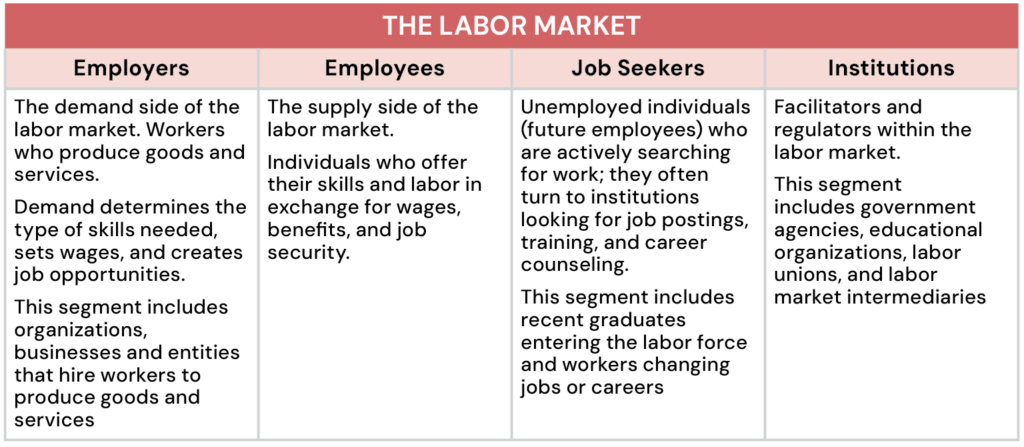
The components of the labor market interact continuously to shape employment rates, wage levels, and economic growth. For example, employers adapt to the availability and skill level of employees, while employees and job seekers respond to wage trends and opportunities. Through regulations and support mechanisms, institutions play a central role in the balancing act by ensuring fairness and enhancing the efficiency of labor compensation exchanges. The ability of the components to support each other’s needs will influence the level of efficiency.
Employers are affected by numerous factors, including economic conditions, industry trends, productivity goals, and labor regulations. On the other hand, employees decide whether to work, where to work, and what skills to develop. Their decisions are prompted by economic pressures, market opportunities and personal goals. Job seekers, who represent a critical subset of the labor supply, are influenced by labor market conditions, job availability, and skill requirements.
The government approves policy and facilitates free market conditions regarding minimum wage, unemployment benefits, and labor protections. Meanwhile, educational institutions provide the skills that workers need to meet employers’ demands; labor unions advocate for workers’ rights, wages, and conditions; and private agencies and programs help match job seekers with employers.
THE WELFARE STATE
A welfare state represents a particular type of governance that assumes responsibility for the economic and social well-being of its citizens by adopting new goals and institutions. The government establishes programs and services to reduce poverty, promote equality, and ensure access to basic needs, such as nutrition, housing, and education. It is grounded in the principles of redistribution, social insurance, and universal benefits to enhance the quality of life and mitigate socioeconomic inequalities.
However, the government could overreach its role by trying to mandate “fair treatment” and a basic standard of living for the poor, a concept that predates the Roman Empire. In the United States, before the 1900s, local governments and private charities were primarily responsible for public assistance, often “public relief”. The role expanded during the progressive era when certain state governments took on more responsibilities to help the poor. The modern welfare program in the United States grew prominently in response to the Great Depression, which exposed severe hardships among the poor and working-class populations.
The New Deal, established by President Franklin D. Roosevelt, marked a turning point in U.S. economic policy with the implementation of federal programs to combat unemployment, poverty, and economic instability. The New Deal included welfare initiatives, such as the Social Security Act, which provided retirement benefits and unemployment insurance; and public work projects, like the Works Progress Administration (WPA), to create jobs. In 1946, the National School Lunch Program was established to provide meals to low-income students to combat malnutrition. Later, programs such as Medicare and Medicaid (1965) expanded healthcare access to seniors and low-income individuals, demonstrating the growing extent of welfare initiatives.
In alignment with Keynesian economics2, through these programs the government intervened to stabilize the economy during the downturn. By increasing public spending and fostering demand, the New Deal did not only mitigate the immediate impact of the Great Depression, but it also laid the foundations for the modern welfare state and set the model for the governments’ response to economic and social inequality.
The adoption of Keynesian policies after World War II throughout Western nations coincided with a significant growth of the welfare state. The concept of automatic stabilizers3 (in relation to economic conditions), such as unemployment insurance and progressive taxation, was introduced.
While Keynesian economics focused on short-term stabilization, critics like Friedrich Hayek and Milton Friedman claimed that emphasis on government spending can undermine long-term economic growth. They argued that market-driven economies, with less government interference, are better positioned to foster innovation, productivity, and sustainable growth. Also, government programs are typically less efficient than market-based solutions because resources are usually misallocated due to political influence and bureaucracy.
On a macroeconomic scale, increased government spending during recessions could lead to inflationary pressures and rising national debt. Friedman maintained that excessive government intervention can undermine economic stability by overstimulating demand and causing inflation. For individuals, long-term dependency on government support discourages self-sufficiency. Large-scale social spending discourages work and stifles individual initiative, leading to economic inefficiency.
The definition of what constitutes welfare expenditure is broad and shifting. For example, it may include subsidies for public transit, the costs caused by legal controls on wages and work conditions or the costs of social services, and other benefits funded by taxes. To frame the discussion regarding Puerto Rico’s welfare state, some of the welfare programs that apply on the island include: The Nutritional Assistance Program (NAP), Temporary Assistance for Needy Families (TANF), Housing Assistance (Plan 8, as commonly known in Puerto Rico), and Medicaid Health Programs, among others.
THE EFFECT OF WELFARE ON POVERTY
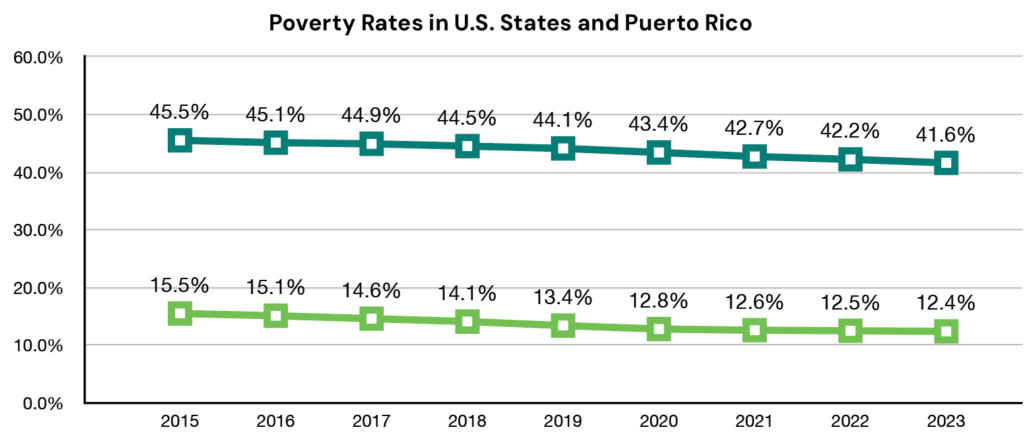
In their book, Cooperation and Coercion, Antony Davies and James B. Harrigan underscore the failures of government in helping those in most need. They focus on the “war on poverty,” which was declared by President Lyndon B. Johnson in 1964. Then, the poverty rate in the United States was 19%.
Over the years, U.S. government has spent more than $22 trillion4 (adjusted for inflation) on programs to fight poverty, but the poverty rate has remained at 11%. According to Davies and Harrigan, “that’s more than three times what the United States has spent on all the actual wars it has fought in its history – combined5.”
The authors argue that despite the whopping investment in anti-poverty measures, there has been “no significant change in the poverty rate for more than forty-five years6.” Instead, it has created a bloated and inefficient bureaucracy that has done little to end poverty.
EMPLOYMENT IN PUERTO RICO
In the early 1900s employment in Puerto Rico was mostly agricultural, shifting to manufacturing in the 1940s with the implementation of Operation Bootstrap (Operación Manos a la Obra). Investment in manufacturing fueled the expansion of the middle class and boosted total employment7, the most significant indicator of economic activity. But, in 2006, after peaking at 1,269,000 employees, total employment began to decrease, mainly due to the expiration of the phase-out period of Section 936. In 2017, employment dropped to its lowest level to 973,000. In other words, over a period of 11 years total employment fell by 23.3%. Meanwhile, the unemployment rate climbed as high as 16.4% in 2010 and remained above 10% until 2017. The labor participation rate decreased by almost 9 percentage points in a decade from 48.9% in 2006 to 40% in 2016.
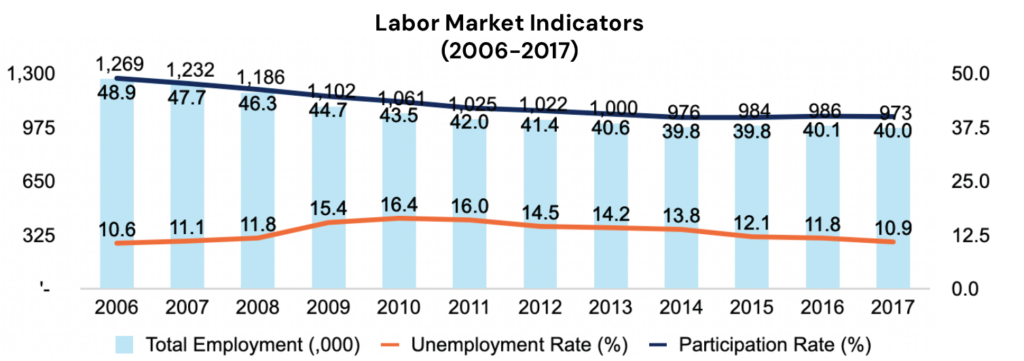
Historically, Puerto Rico has faced persistently high rates of unemployment, often exceeding double digits, even during periods of economic growth. Migration to the U.S. mainland, has alleviated local unemployment pressures, but at the expense of reducing the island’s working-age population and economic potential.
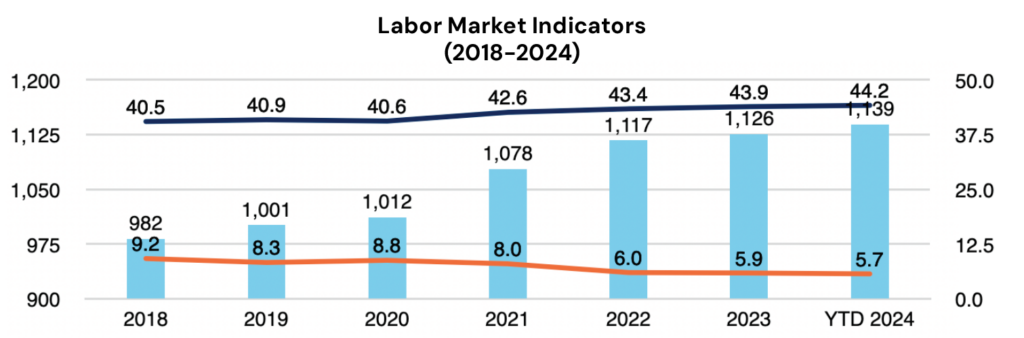
Since 2017, Puerto Rico has received more than $69.5 billion8 in federal disaster relief funds due to hurricanes Irma and Maria in 2017 –which caused $80 billion in damages9– and the COVID-19 pandemic in 2020. Said influx of money has driven public investment and the labor market, restoring conditions for economic growth for the first time since 2016. From 2018 to 2024, employment grew by 16%, the unemployment rate dropped to a record low, and labor participation increased. Employment growth highly correlates (R²=.91) with the disbursement of funds from Community Development Block Grant Programs (CDBG), which is expected to continue until 2035.
However, the creation of new jobs is not evenly distributed across all sectors of the economy. For example, during the past five years, the construction industry has added 10,000 new jobs for a 32.8% growth. Similarly, the Leisure and Hospitality segment has grown by 26.5%, adding jobs in the tourism and restaurant industries. Demand for workers in the construction sector will remain strong due to the investment of federal funds in reconstruction projects, which will require as many as 30,000 additional workers during the next few years. In the restaurant industry there are approximately 4,000 vacancies waiting for new hires.
Nevertheless, Puerto Rico has the lowest labor force participation rate in the U.S. Contributing to the disparity are structural issues such as lower wages, higher unemployment rate, and mismatches between the workforce skills and available jobs.
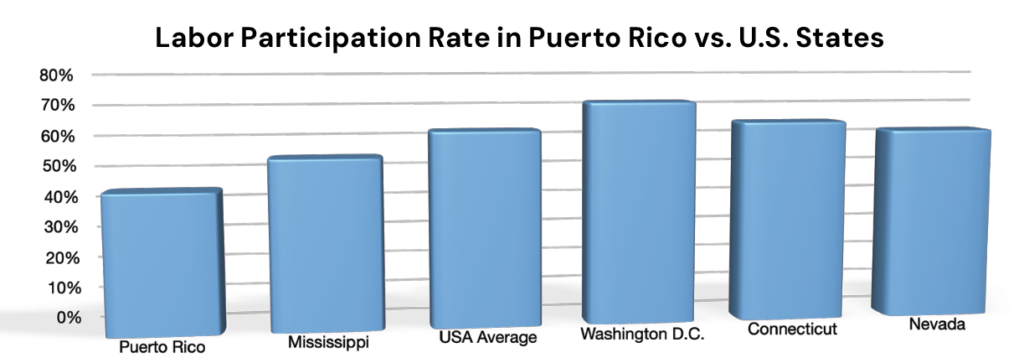
The labor participation rate is influenced by a combination of economic, demographic, social, and policy-related considerations. Regarding social factors, Puerto Rico has progressive social norms that encourage women to work, yet the female labor participation rate is lower than the male. Data shows that more women (34.9% ) pursue university than men (26.0%)10, yet the female labor participation rate is 37.8%, much lower that the male, which stands at 52.4%. Most of the women who are not in the labor market stay at home taking care of children or elderly relatives, since familial responsibilities often fall disproportionately on women, reducing their ability to participate in the labor force.
Dependency on welfare programs also affects labor participation. According to data, more than 40% of the population in Puerto Rico is dependent on welfare assistance, discouraging work in the formal economy and affecting the labor participation rate. Welfare beneficiaries often choose to work outside the formal labor force to protect benefits.
LABOR PARTICIPATION RATES (%) FOR MEN AND WOMEN
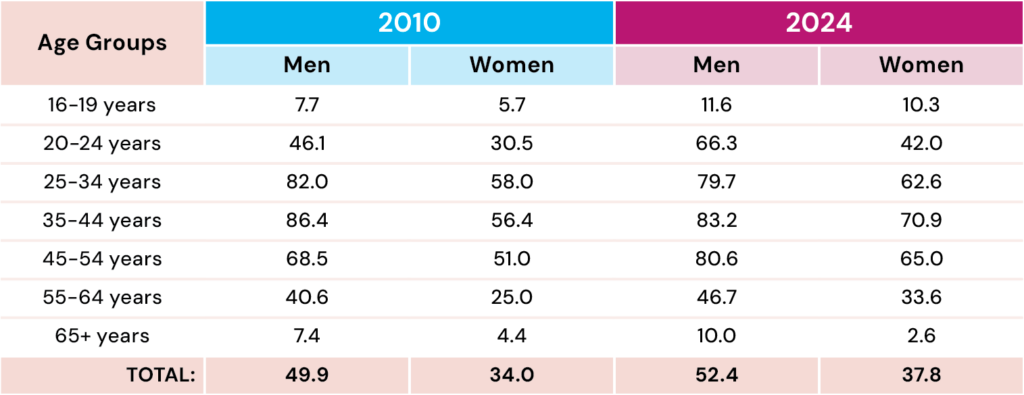
Since 2010, overall labor participation rates have increased, because women are entering the labor market earlier and men are working longer. In addition, male participation rate is increasing as more men are postponing retirement and working longer.
WAGES
Increased competition in the job market has put upward pressure on wages. As wages increase, working becomes more attractive relative to other alternatives, including unemployment, studying, or dependency on household income or welfare benefits.
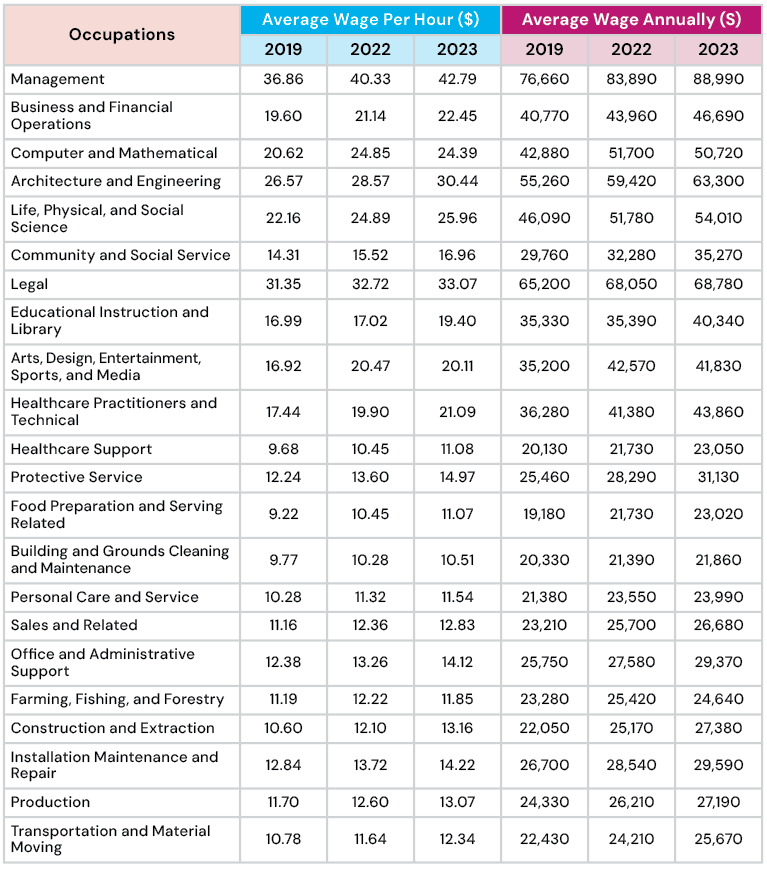
When the household’s primary earners have a high wage, the secondary earners (often women) tend to stay out of the workforce if their wages are perceived to be too low relative to the cost of working (i.e., childcare and transportation). As wages become increasingly attractive, so is the likelihood of secondary earners entering the formal labor market.
Yet, wage increases affect the capacity of underpaid or low-income workers to transition from welfare programs to full-time formal employment, because they could lose welfare benefits (i.e., NAP or Medicaid) and a reduction in net income. As a result, they are discouraged from working more hours or seeking higher-paying jobs to avoid exceeding the earnings threshold and to protect benefits.
In Puerto Rico, wages are increasing organically driven by supply and demand, and through legislation. By the end of 2023, the average hourly wage had increased to $16.40, up by 86 cents from 2022 and by $2.12 from 2019. Legislation increased the hourly minimum wage 3 times between 2021 and 2024, from $7.25 in 2021 to $8.50 on January 1, 2022; to $9.50 on July 1, 2023; and to $10.50 on July 1, 2024.
INFORMAL ECONOMY
The informal economy plays a huge role in Puerto Rico’s labor market and the welfare state. Informal economic activities are not regulated by the government and often operate outside formal labor laws, tax systems, and social protections.
In 2014, the accounting firm, KPMG, estimated the island’s informal economy at $22 billion. According to the U.S. Senate Finance Committee “It is widely assumed that at least 25% of economic activity in Puerto Rico is “off the books” and is not measured by official data11.”
Although informal work can provide income for individuals lacking access to formal employment, it is often characterized by low wages, poor working conditions, and limited job security. The informal economy may serve as an alternative to formal employment, but this comes at the cost of reducing official labor force participation rates. People who face barriers to entering the formal labor market—such as limited skills, high compliance costs, or the loss of welfare benefits—may turn to informal work as a more accessible option.
FINDING BALANCE BETWEEN WAGES AND WELFARE PROGRAMS
OPPORTUNITY COST
To show the interaction between wages and welfare, this study analyzed the opportunity cost of working for participants in the following programs: NAP, TANF, Housing Assistance (Plan 8, as commonly known in Puerto Rico), and Medicaid. The exercise compared monthly income received from working (based on minimum wage rate) and welfare (based on high-end brackets).
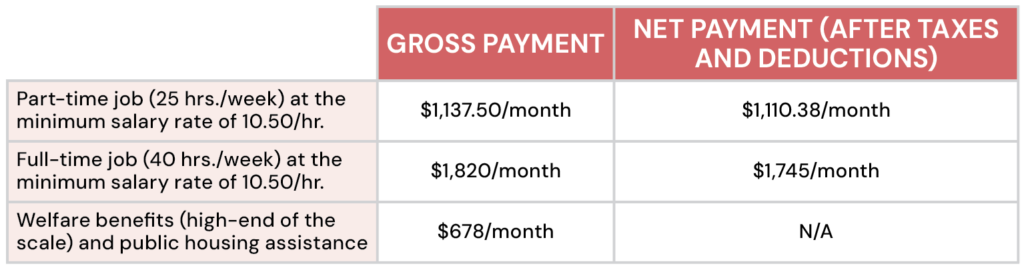
A person working part-time (25 hrs./week) at the minimum wage rate of $10.50/hr. will make an average gross income of $1,137.50/month for a net pay (after taxes and deductions) of $1,110.38/month. A person working full-time (40 hrs./week) at the minimum average wage rate of $10.50/hr. will make an average gross income of $1,820/month for a net pay (after taxes and deductions) of $1,745/month. On the other hand, a welfare beneficiary at the higher end of the benefits’ scale and receiving public housing assistance could get $678/month. In terms of income, the advantage of working part-time compared to social assistance is $459.50, which vanishes when considering the expenses related to taking a job, such as meals, transportation, and care for infant, elderly, or disabled dependents. As a result, the opportunity cost of taking a job is negative compared to welfare benefits.
Yet, welfare programs are meant to provide temporary assistance, not a permanent way of living. According to CRECE’s “Freedom to Prosper in Puerto Rico” study, 74% of the respondents said it is important or very important not to depend on government or others for sustenance, 46% said government programs discourage work, and 51% believe that welfare programs have not been successful.
The government must focus on creating conditions that promote work as a means of living and discourage dependance, even if strict earnings thresholds in certain programs are impacting official labor participation rates among welfare beneficiaries. In that sense, Puerto Rico’s government has recently taken steps in the right direction, requiring welfare beneficiaries to work while maintaining benefits.
ENCOURAGING WORK AMONG WELFARE BENEFICIARIES
Understanding Earnings Thresholds and Benefit Cliffs
To effectively encourage work among welfare beneficiaries, it is crucial that both the local and federal governments understand how wages, labor market, and welfare programs interact among each other and what are the potential consequences, including how earnings thresholds can lead to benefit cliffs.
Benefit cliffs occur when a beneficiary’s earnings exceed the specified earnings threshold (or maximum), even by $1.00, causing a sudden and disproportionate loss of welfare benefits. In this scenario, the individual’s financial situation worsens despite having more earnings. In consequence, the possibility of facing a benefit cliff discourages beneficiaries from working in the formal economy and their interest in making more money or moving upward. Benefit cliffs become poverty traps that limit working and self-sufficiency.
Welfare programs like Medicaid, the NAP, and housing assistance have strict income requirements that lead to the abrupt cancellation of benefits when earnings exceed the eligibility threshold. In the case of Medicaid, beneficiaries face losing comprehensive healthcare coverage and significant need. Similarly, there are childcare assistance programs that apply sudden cutoffs based on income thresholds that leave working parents uncovered and coping with steep medical costs.
For example, workers earning $20,000/year might receive $4,000/year in NAP benefits and housing subsidies. But, if their income rises slightly by $10/year to $20,010/year, they will lose $4,000/year in benefits, causing a real reduction in total disposable income despite having “higher” earnings.
Avoiding Abrupt Loss of Benefits
The Earned Income Tax Credit (EITC) program has a gradual phase-out of benefits as income rises, reducing the possibility of abrupt cuts and encouraging beneficiaries at the lower end of the earnings scale to stay in the formal workforce and pursue higher earnings. EITC provides a tax credit for workers with low to moderate incomes that can be used to pay outstanding taxes or as a refund. The credit is based on income, filing status and number of qualifying children. EITC serves to encourage work and alleviate poverty because, unlike traditional welfare benefits, it rewards work and upward mobility (up to a certain point). Individuals are motivated to stay in the formal workforce and increase earnings to achieve financial freedom.
Another tax incentive provided by the government that is rendering positive results is the Child Tax Credit (CTC). The program seeks to reduce the financial burden on families with young children up to 16 years and promote their well-being. The tax credit serves to offset the costs of raising children. In 2024, the maximum credit per eligible child was $1,700.
The case for Cuna de Talentos
In 2023, Puerto Rico’s Department of Family (DF, for its acronym in Spanish) and the Department of Economic Development and Commerce (DDEC, for its acronym in Spanish) announced a collaborative initiative under the name of Cuna de Talentos (Cradle of Talents). After completing a pilot phase in the municipality of Carolina, the program was launched throughout the island. The program’s objectives align with broader goals to expand the labor market, improve socioeconomic conditions, and foster sustainable economic development on the island.
Cuna de Talentos aims to increase financial freedom among eligible NAP recipients by encouraging them to work, knowing their nutritional benefits are protected. It targets individuals between the ages of 18 to 54 without dependents – excluding mothers or heads of families taking care of minors, injured employees, pregnant women, people with functional diversity and homeless individuals. Through Cuna de Talentos participants can meet one of the following requirements: work 20 hours per week, enroll in training or educational program or complete 20 hours of voluntary work per week. According to estimates, in Puerto Rico 220,000 individuals are eligible to participate in this program.
CONCLUSIONS
Work is a complex experience that affects people differently based on their job, workplace, and values. Some find it fulfilling and prideful, while others see it as stressful and tedious. These feelings depend on the nature of the work and the work culture. Despite varying perceptions, work is essential for societal progress.
Welfare programs are also needed in society because they provide a crucial safety net for individuals coping with economic needs as they work to achieve long-term self-sufficiency. Assistance to meet basic needs, such as food, housing, and healthcare, is meant to be temporary. Therefore, government must act to implement initiatives to encourage individuals to transition from welfare to sustained economic independence through employment.
As shown in this report, programs like Medicaid, NAP, and TANF, have inherent challenges that discourage work or higher earnings, perpetuating dependency. Factors, like the benefit cliffs and earnings thresholds, create barriers for individuals to work, impacting official labor participation and economic growth.
To modify the course, policymakers must reform welfare programs to focus on self-sufficiency, instead of dependency, incorporating initiatives that encourage work and higher earnings, like EITC and CTC. Cuna de Talentos is also a great tool to encourage lower-income households to gradually increase their income in the formal labor market while protecting crucial benefits.
RECOMMENDED STRATEGIES TO ADDRESS BENEFIT CLIFFS AND EARNINGS THRESHOLDS
- Implement gradual phase-out of benefits as earnings increase to avoid abrupt loss or cancelation of benefits.
- Rise income thresholds and consider inflation and cost of living in the region to reduce the incidence of benefit cliffs.
- Add supplemental earnings programs, like EITC, to reward formal employment, work, and earnings, while offsetting the loss of other benefits.
Complementing welfare assistance with initiatives to boost labor participation and upward economic mobility, will also increase the effectiveness of welfare programs. By encouraging labor participation among welfare recipients, the government will promote economic development, equal access to opportunities, reduce poverty, and bring private investment to the island.
As the labor market continues to grow over the next few years, Puerto Rico must take the opportunity to reform welfare assistance programs and assertively encourage work to elevate the island’s labor participation above 50% and increase self-sufficiency.
APPENDIX
WELFARE PROGRAMS IN PUERTO RICO
The following provides a brief description of the most important welfare programs in Puerto Rico.
Nutrition Assistance Program (NAP) /
Programa de Asistencia Nutricional (PAN)
The Nutritional Assistance Program (NAP), locally known as “Programa de Asistencia Nutricional” (PAN), is Puerto Rico’s equivalent of the U.S. Supplemental Nutrition Assistance Program (SNAP). It provides financial aid to low-income individuals and families to purchase food. Unlike SNAP, which is an entitlement program, NAP operates under a federal block grant, meaning that funding has an annual cap that limits the number of beneficiaries and benefits.
Previously, from 1974 to 1982, Puerto Rico was part of the federal Food Stamp Program (FSP). Like in the U.S. mainland, the FSP on the island provided direct benefits. But, in 1982, the U.S. Congress, citing cost concerns and logistical challenges, replaced the FSP with NAP. While the block grant program gives the Government of Puerto Rico flexibility to administer the program, it comes at the expense of funds. Advocates of securing parity with SNAP argue that the block grant structure limits benefits, particularly during economic downturns or natural disasters. The U.S. Congress approved temporary increases in funding in response to events like Hurricane Maria in 2017 and the COVID-19 pandemic.
In 2021, the distribution systems of NAP benefits changed from paper vouchers to an Electronic Benefits Transfer (EBT) card.
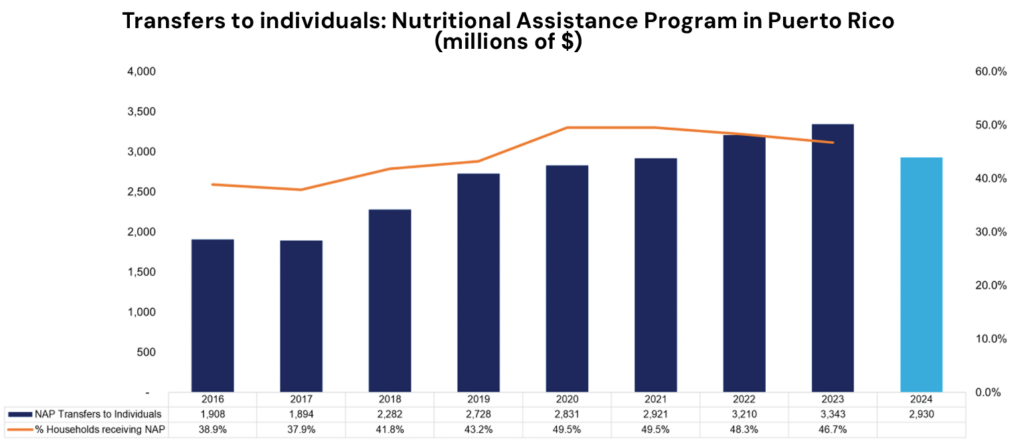
Under NAP, the monthly benefit per person is $165 for residents of Puerto Rico’s main island and $198 for residents of Vieques and Culebra. Meanwhile, a family of 4 living in Puerto Rico’s main island could receive up to $551/month in NAP benefits, much lower than the $680/month in SNAP benefits for a family of 4 in the U.S. mainland.
Medicaid
Medicaid operates with federal and state funds to provide healthcare to low-income individuals, including the elderly, pregnant women, children and people with disabilities. The program was created by the federal government in 1965 under the XIX of the Social Security Act and extended to Puerto Rico in 1968. The local Medicaid program operates different from its counterparts in U.S. states due to funding caps and other restrictions.
Puerto Rico’s Medicaid funding is capped annually, unlike the entitlement system used in U.S. states, where federal funding increases according to need. Locally, the gap in funding has led to fewer benefits and limited coverage compared to U.S. states.
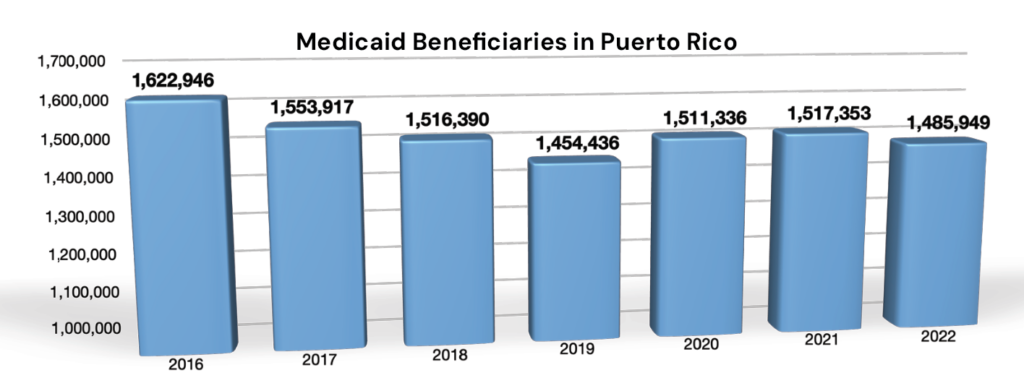
The U.S. Congress approved increases in Medicaid’s capped amount for Puerto Rico through temporary funding adjustments due to the natural disasters of hurricanes Irma and María and the COVID-19 pandemic. In December 2022, Congress approved funding for the island’s Medicaid program for five additional years, beginning in Fiscal Year 2023 with $3.28 billion until Fiscal Year 2028 with $3.83 billion. Moreover, the agreement increased to 76 cents the share of Medicaid costs paid to Puerto Rico by the federal government.
Each year, Medicaid spends in Puerto Rico between $2,000 and $2,500 per beneficiary, much lower than in U.S. states where spending ranges from $8,000 to $10,000 per beneficiary. The significant gap in spending indicates funding limitations and differences in the cost structure of healthcare services on the island. Medicaid fund allocations in Puerto Rico include direct medical benefits to beneficiaries (i.e., hospital visits, preventive care, medical procedures), resources managed by health care organizations, and the program’s administrative budget (i.e., payroll, claims and payment).
Nationally, Medicaid administrative costs represent 5% to 10% of total Medicaid spending. In some cases, costs are higher, especially in jurisdictions with complex or underfunded systems like Puerto Rico.
For this analysis, we are assuming that local administrative costs account for 20% of Medicaid’s total spending in Puerto Rico. As a result, participants on the island effectively receive only 80% of the allocated funds in benefits, which is less than other jurisdictions in the U.S. where benefits to participants range between 90% and 95% of total spending. Locally, Medicaid beneficiaries receive approximately $1,600 to $2,000 per year, or about $150 per month.
Temporary Assistance for Needy Families (TANF)
TANF is a program that provides cash assistance and support services (i.e. work readiness, and job training, among others) to low-income families with children. It aims to reduce poverty, promote self-sufficiency through work, and support family stability. Funding comes from federal block grants to states and territories, and additional local contributions. The program is implemented locally using the same structure as U.S. states.
To be eligible to receive TANF benefits, families must have at least one dependent 18 years or younger (up to 19 years if still in high school). In 2024, TANF in Puerto Rico reported a participation of 2,380 households and 6,601 individuals. Locally, a family of 3 could receive between $180 and $300 per month, much lower than the average monthly benefit in the U.S. states, where a family could receive from $400 to $1,000, depending on the state.
Special Supplemental Nutrition Program
for Women, Infants, and Children (WIC)
The WIC program in Puerto Rico operates similarly to the U.S. mainland to provide nutrition assistance to low-income pregnant women, breastfeeding mothers, postpartum women, infants, and children up to age five. The program is designed to ensure proper nutrition during critical stages of development and reduce health disparities.
To be eligible participants must meet income guidelines – at or below 185% of the federal poverty threshold – and be considered “at nutritional risk,” as determined by a health professional. Participants receive monthly food packages (via vouchers or electronic benefits transfer – EBT cards) to purchase specific products.
In Fiscal Year 2024, Puerto Rico received between $250 million and $300 million for the WIC program. Funds depend on federal budgets and caseload projections. The program serves between 100,000 to 120,000 participants/month. On average, WIC beneficiaries in Puerto Rico receive monthly benefits between $50.00 and $60.00/person for nutritional needs covered under the program, including infant formula and baby foods, dairy products, protein sources, and more.
HOUSING ASSISTANCE
As in the U.S. mainland, housing assistance in Puerto Rico is primarily administered through programs funded by the U.S. Department of Housing and Urban Development (HUD). These programs aim to provide safe, affordable housing for low-income families, elderly individuals, and people with disabilities. Residents of Puerto Rico are eligible for federal housing programs, like Section 8 vouchers and support from HUD, although funding and availability could be limited. Puerto Rico receives between $500 million and $700 million annually for housing programs, and additional funding for disaster recovery.
Main Housing Assistance Programs in Puerto Rico
- Section 8 Housing Choice Voucher Program: Provides rent subsidies for low-income households, allowing them to afford private rental housing. Recipients pay 30% of their monthly income toward rent, and the voucher covers the difference (up to a local fair market rent limit). The average annual benefit for a household in Puerto Rico ranges between $6,000 to $9,000, depending on local fair market rents and household size.
- Public Housing: Puerto Rico has one of the largest public housing systems under HUD. Public housing developments are owned and managed by the Puerto Rico Public Housing Administration (PRPHA). Rent is capped at 30% of household income. Residents of public housing benefit from significantly reduced rent, often paying less than $300/month.
- Emergency Housing Assistance: HUD provides funds for disaster-related housing needs through programs like Community Development Block Grant – Disaster Recovery (CDBG-DR) and FEMA assistance. These funds were vital after hurricanes like Maria (2017) and Fiona (2022). Individual grants for home repairs or temporary housing can range from $5,000 to $20,000, depending on the extent of the damage.
- Homeownership Support: The Federal Housing Administration (FHA) offers mortgage insurance programs to help low-income families buy homes. Other HUD programs, such as HOME Investment Partnerships, support the construction or rehabilitation of affordable housing.
Summary of Programs and Benefits
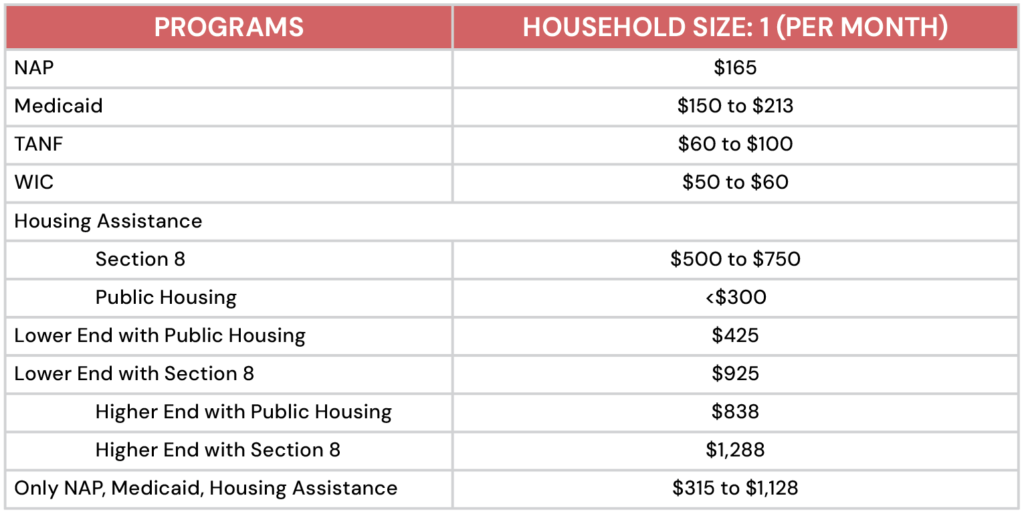
If a person participates in all programs, benefits could range from $425 to $925 per month at the lower end of the scale and Section 8 assistance. Participants at the higher end of the scale could receive from $838 to $1,288/month in benefits and Section 8 assistance. Certain programs, like TANF and WIC, require participants to have at least one qualifying child. Beneficiaries of NAP, Medicaid, and Housing Assistance receive between $315/month and $1,128/month.
REFERENCES
- American Poverty in Three Charts. (2022, January 26). Retrieved from USA Facts: https://usafacts.org/articles/american-poverty-in-three-charts/
- Andrew F. Arena, S. M. (2023). Mental Health and Unemployment: A Systematic Review and Meta-Analysis of Interventions to Improve Depression and Anxiety Outcomes. Journal of Affective Disorders, 450-472.
- Autor, D. H. (2015). Why Are There Still So Many Jobs? The History and Future of Workplace Automation. Boston: MIT University.
- Baten, J. (2016). A History of the Global Economy: From 1500 to the Present. Cambridge: Cambridge University Press.
- Davies, A., & Harrigan, J. B. (2020). Cooperation & Coercion. Wilmington, DE: ISI Books.
- Duncan, R. D. (2021, December 1). The Why of Work: Purpose and Meaning Really Do Matter. Retrieved from Forbes: https://www.forbes.com/sites/rodgerdeanduncan/2018/09/11/the-why-of-work-purpose-and-meaning-really-do-matter/
- (2024). Freedom to Prosper in Puerto Rico. Centro para Renovación Económica, Crecimiento y Excelencia (CRECE).
- Glassman, B. (2019, September 26). More Puerto Ricans Move to Mainland United States, Poverty Declines. Retrieved from US Census Bureau: https://www.census.gov/library/stories/2019/09/puerto-rico-outmigration-increases-poverty-declines.html
- Paul, C. A. (2017). President Roosevelt’s New Deal. Richmond, Virginia. Retrieved from https://socialwelfare.library.vcu.edu/eras/great-depression/the-new-deal/
- Rust, O. (2024, January 1). The History of Social Welfare Programs (& Current Debates). Retrieved from The Collector: https://www.thecollector.com/history-social-welfare-programs/
- Selgin, G. (2022). The New Deal and Recovery, Part 15: The Keynesian Myth. 2022: Cato Institute.
- Situación económica de la industria de restaurantes y distribuidores en Puerto Rico. Asociación de Restaurantes de Puerto Rico (ASORE).
- Temporary Assistance for Needy Families (TANF) Block Grant: Responses to Frequently Asked Questions. (2024, April 1). Retrieved from Congressional Research Service: https://crsreports.congress.gov/product/pdf/RL/RL32760/228
- Vélez, G. (2023, August 8). Puerto Rico y la fábrica de pobreza. Retrieved from El Nuevo Día: https://www.elnuevodia.com/opinion/hablemos-de-economia/notas/puerto-rico-y-la-fabrica-de-pobreza/
- Werner Eichhorst, A. H. (2020). Welfare States, Labor Markets, Social Investment and the Digital Transformation. Bonn: IZA Institute of Labor Economics.
- Mental health and unemployment: A systematic review and meta-analysis of interventions to improve depression and anxiety outcomes.
↩︎ - Keynesian economics, developed by John Maynard Keynes, emphasizes the role of government intervention in stabilizing the economy, particularly during downturns when private sector demand is insufficient. Keynes argued that increased government spending and targeted fiscal policies could stimulate economic activity, reduce unemployment, and foster growth. This theory directly influenced the development and expansion of welfare programs, as such programs act as “automatic stabilizers” by supporting consumer demand during recessions. For example, unemployment benefits, social security, and public works initiatives are rooted in Keynesian principles, as they help mitigate the impacts of economic crises while promoting long-term stability. These ideas were central to the New Deal programs in the U.S., demonstrating the practical application of Keynesian economics to social welfare policy.
↩︎ - Automatic stabilizers are a type of fiscal policy designed to offset fluctuations in a nation’s economic activity through their normal operation without additional, timely authorization by the government or policymakers. (Investopedia)
↩︎ - Figure does not include Social Security and Medicare spending.
↩︎ - Davies, A., & Harrigan, J. B. (2020). Cooperation and Coercion (p. 106).
↩︎ - Davies, A., & Harrigan, J. B. (2020). Cooperation and Coercion (p. 108).
↩︎ - Seasonally adjusted. Total employment includes individuals employed in all sectors, including agriculture and self-employment,
↩︎ - Financial Oversight and Management Board of Puerto Rico. Restoring Growth and Prosperity, 2024 Fiscal Plan for Puerto Rico. June 5, 2024
↩︎ - FEMA. Mitigation Assessment Team Report. Hurricanes Irma and Maria in Puerto Rico. Building Performance, Observations, Recommendations, and Technical Guidance. October 2018
↩︎ - U.S. Census Bureau. Table S1501 Educational Attainment. 2023 ACS 1-Year Estimates
↩︎ - Arthur MacEwan and J. Tomas Hexner. Establishing Reliable Economic Data for Puerto Rico. GDS Working Paper. Brandeis University, The Heller School for Social Policy and Management. October 11, 2016.
↩︎