
THE 2022 AND 2026 OIL SHOCKS: IMPLICATIONS AND POLICY OPTIONS FOR PUERTO RICO
BY: Gabriel Capella
Research Associate
1. Introduction
In February of 2022, Russia invaded Ukraine and sent global energy markets reeling. The nominal price of West Texas Intermediate (WTI) crude oil climbed from $92 a barrel to a peak of $124 two weeks after the start of hostilities, a surge of about 35%. Prices held in the $100 to $120 range until July of 2022 and remained elevated above pre-pandemic levels through the end of 2025. In February of 2026, just two months after prices seemed to have returned to their pre-pandemic average, another major oil shock hit the global economy when the United States (U.S.) and Israel launched targeted strikes against Iran. The International Energy Agency called the event the “largest [physical] supply disruption in the history of the global oil market.”
The conflict in Iran caused the closure of the Strait of Hormuz, which served as passage for 20% of the world’s daily petroleum supply before the war. As a result, the price of WTI oil climbed from $66 a barrel on February 27 to a peak of $115 on April 7. This represented an increase of 74%, roughly double the 35% surge seen in 2022. Moreover, following reports of a peace agreement between the U.S. and Iran, prices fell sharply, from approximately $96 per barrel to about $76 as of June 20. This means that both events seem to have been at least close to comparable in terms of duration.
The 2026 shock hit Puerto Rico’s economy at a time when macroeconomic conditions and headwinds differed markedly from those of 2022. As such, it will be crucial for policymakers and the private sector to act with urgency and flexibility if adverse effects are to be mitigated and stronger growth over the short run is to be achieved. This brief presents evidence on the effects of the 2022 event on key economic variables, how those variables could behave in the current scenario, and what policymakers can do to mitigate the impact.
2. The Effects of the 2022 Shock
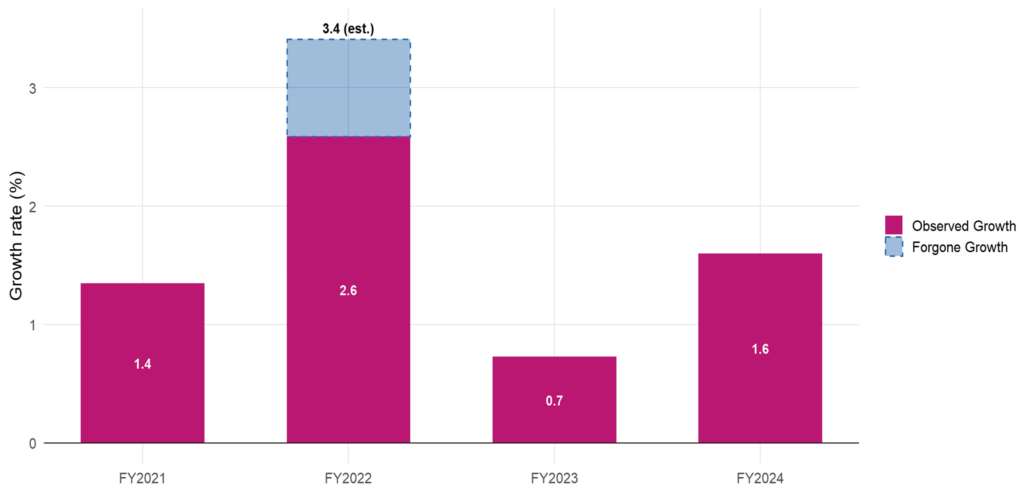
In Puerto Rico, the price of a liter of gasoline at the pump jumped from an average of 79¢ in 2021 to an average of $1.13 between February and August of 2022. This represented an increase of 43%, which came directly out of consumers’ and businesses’ pockets, since gasoline is generally inelastic with respect to price. Elasticity measures the degree to which the quantity demanded of a good responds to a change in its price. The temporary increase of 34¢ per liter in the price of gasoline cost the economy around $628 million, or $543 million in 2017 dollars. This large pass-through likely took around 0.6 to 0.8 percentage points off real gross national product (GNP) growth in fiscal year 2022.1 Because Puerto Rico imports all the petroleum products it consumes, increased spending on gasoline represents mostly a net outflow of income from the local economy to global commodity producers.
Figure 1. The spike in gasoline prices cost Puerto Rico more than half a point of real GNP growth in fiscal year 2022
Increased gasoline prices were also reflected in sharp spikes in the local consumer price index (CPI) and its transportation component, which surged 15.6% year over year in June of 2022 alone (Figure 2).
Figure 2. The 2022 oil shock drove Puerto Rico’s transportation inflation above 15%
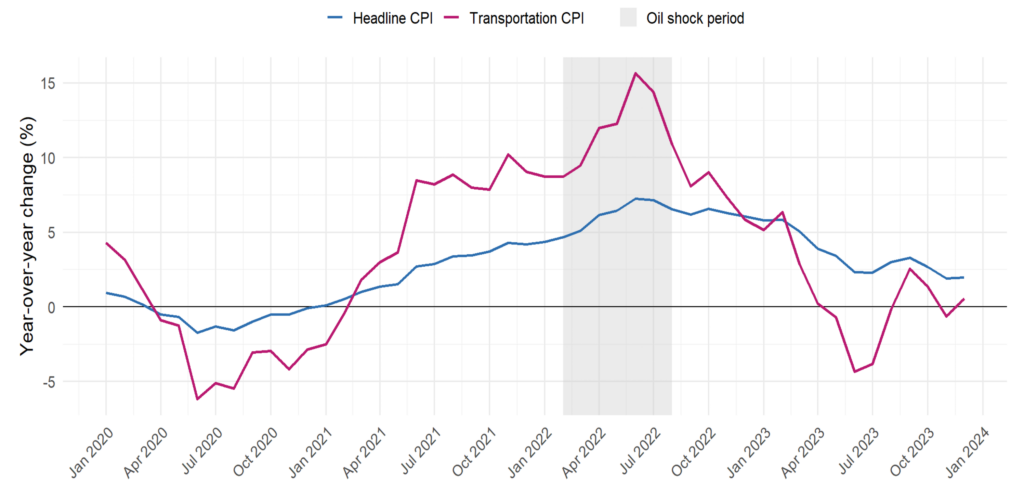
Transportation costs had been surging since the start of 2021 as economic activity began to normalize after pandemic closures. Globally, the price of WTI climbed from a low of $17 per barrel in April of 2020 to an average of $68 in 2021. The rapid increase in local transportation costs observed in the first half of 2021 normalized in the latter half of that year, only to spike back up markedly after February of 2022.
Rising energy prices also pushed up average electricity prices, which reached 34.7¢ per kilowatt-hour in July of 2022.2 This represented an increase of 59% and 35% compared to July of 2021 and January of 2022, respectively. Such large spikes represented a heightened burden on household budgets, business operations, and economic activity in general.3 Figure 3 shows electricity-cost pressure relative to the Economic Activity Index (EAI), indexed to February of 2022.4
Figure 3. Puerto Rico’s electricity-cost pressure spiked after the 2022 oil shock
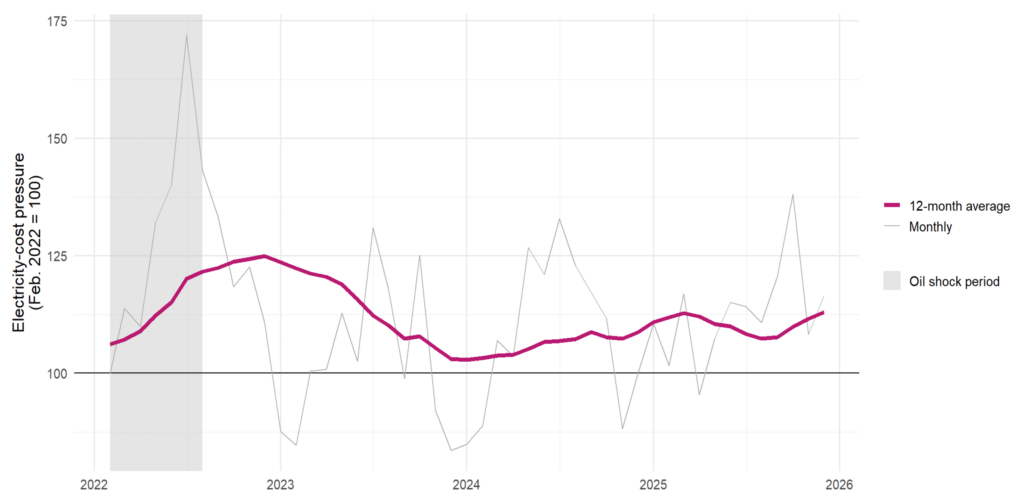
Note: The 12-month average tracks the underlying trend, smoothing the large swings shown in the monthly series.
As depicted in Figure 3, electricity-cost pressure grew fast during the initial months of the shock. This was the case because electricity prices rose, while electricity consumption and the EAI remained roughly flat. The pressure kept growing into the summer and well into the final months of 2022 as electricity prices remained elevated and consumption rose. It was not until late in 2023, a year and a half after the shock, that electricity spending relative to the EAI returned to its pre-shock level. Figure 4 shows the behavior of these two variables, along with gasoline prices, indexed to February of 2022.
Figure 4. Gasoline prices, electricity prices, and the Economic Activity Index, indexed to February of 2022
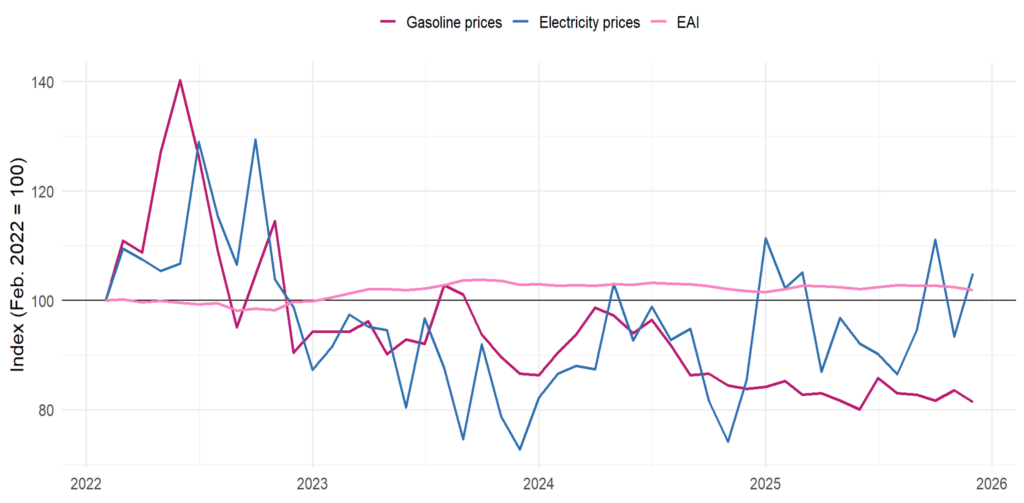
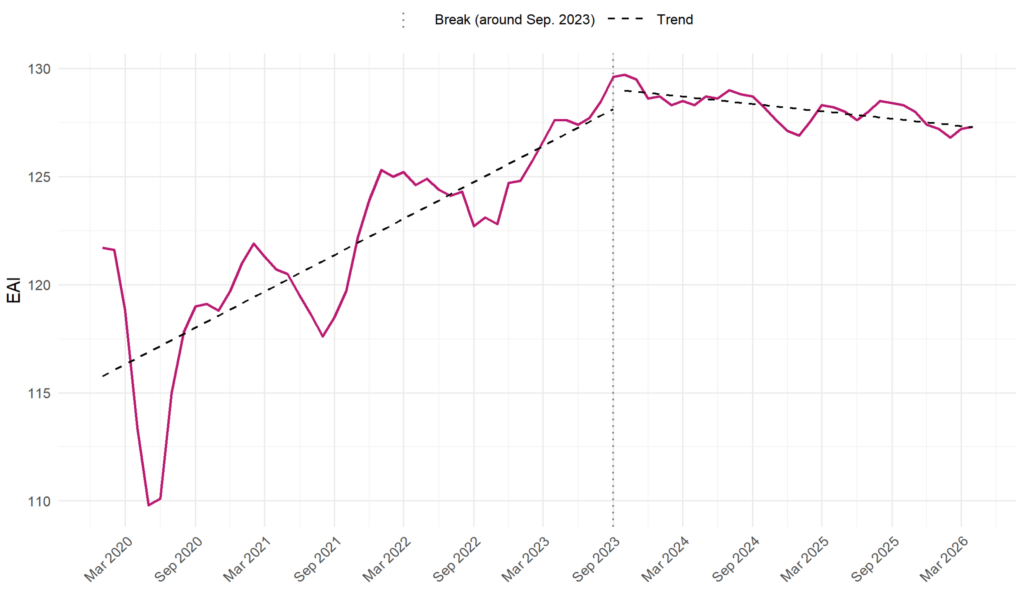
Figure 4 shows that gasoline prices peaked before average electricity prices and that both returned to their pre-shock levels in around December of 2022, 10 months after the initial oil shock. The EAI grew just 0.6% in 2022—in part due to the shock’s effects—after a sharp rise of 3.5% in 2021.5 Setting aside 2023, which saw steady growth, the EAI’s flatness into 2024 and 2025 is striking. It reflects not just the absence of sustained growth, but the absence of the multi-year bump that federal post-Maria and pandemic spending many expected to produce. This suggests that Puerto Rico’s recent macroeconomic performance may be more nuanced than real GNP growth implies, and that the standard tendency to credit federal funds with driving growth overstates their role as true expansion rather than mere stabilization.6 The next section discusses Puerto Rico’s recent economic conditions in the context of the 2026 oil shock.
3. Why the 2026 Shock is More Dangerous
Puerto Rico’s macroeconomy enjoyed several tailwinds coming out of the 2020 pandemic, which likely muted the effects of the 2022 shock. After dropping 10% between February and May of 2020, the EAI had a strong post-pandemic restart, returning to its February of 2020 level by February of 2021. As mentioned in the previous section, the EAI exhibited strong growth of 3.5% in 2021. Such immediate resilience was in part supported by massive rounds of federal post-Maria reconstruction funds and pandemic stimulus—which propped up consumer spending and capital formation and sustained fiscal budgets—and near-zero interest rates. The U.S. economy was also resilient, growing 6.1% in 2021.
Another important factor explaining Puerto Rico’s post-pandemic experience is growth in the labor market. Total nonfarm employment grew steadily from May of 2020 onward, reaching 947,000 payrolls in December of 2022. That level of employment was last observed in August of 2009, and was up 8% from the 2019 average of 880,000. Moreover, the labor force participation rate climbed from 39.8% in February of 2020 to 45% in December of 2021, and private employment reached a 16-year high of 750,000 persons in December of 2022. All in all, a growing labor force contributed to more economic activity, though the reverse may also hold—a recovering economy and rising wages attracting more workers.7
In 2026, however, Puerto Rico’s macroeconomic conditions are different, making the current oil shock and geopolitical uncertainty more acute. This is the case for two main reasons. The first one is that, as established in the previous section, the EAI has exhibited a pattern of stagnation over the past two years (Figure 5).
Figure 5. The Economic Activity Index became stagnant after 2023
Second, although total nonfarm employment hit a 17-year high of 958,000 workers in April of 2026, growth momentum appears to have softened considerably. After expanding by more than 5% in both 2021 and 2022, average-annual employment growth slowed to roughly 2% in 2023 and 1% in 2024 before turning slightly negative in 2025. This loss of momentum, which mirrors the EAI’s flattening, left the labor market with little forward thrust heading into the 2026 shock.
Added onto this picture of dual stagnation are the adverse effects of the new U.S. tariff and trade policies implemented in 2025. A recent study by the Puerto Rico Institute of Statistics estimated the cost of the tariffs at close to $1 billion in 2025 alone.8 Moreover, we recently estimated that a $30-per-barrel increase in oil prices—roughly the level that the 2026 shock had sustained as of early June—would have cost the economy more than $1 billion a year.9 Over just two years, that drag would have accumulated to the nearly $2.3 billion in investment the government’s recent reshoring push has secured, before counting the cost of tariffs. Even as prices have dropped significantly following the announcement of a peace agreement between the U.S. and Iran, the shock’s impact on the economy will linger into late 2026 and potentially 2027. 10All of this—combined with cooling consumer spending and interest rates higher than in early 2022—makes the 2026 shock more dangerous for Puerto Rico’s growth prospects.
In short, the downside risk to growth, already elevated entering 2026, has been compounded by an oil shock and by mounting tariff pressures across the economy. The public and private sectors must therefore act to reduce the economy’s exposure and restore sustained growth over the medium term. Potential courses of action are discussed in the next section.
4. Policy Options
- Suspend the “crudita.” Retail voices have pressed to suspend the petroleum excise (known as the “crudita”) to mitigate the rise in fuel prices. A recent legislative proposal would suspend both the initial 2013 per-barrel tax of $9.25 and the 2015 add-on of $6.25 for 90 days. Although such a suspension would cost the government close to $100 million, the proposal caps it at $60 million. This would have a significantly bigger fiscal impact than an alternative measure to suspend the excise on gasoline and diesel for 45 days (≈$20 million in fiscal impact).11 The economic impact, however, would likely exceed the fiscal cost: the forgone revenue stays in the hands of consumers and businesses, whose spending recirculates through the local economy.
- Suspend the prepared-food tax. A proposal to suspend the 7% sales tax on prepared food for 90 days—at an estimated fiscal cost of about $63 million—would put money back in consumers’ pockets and boost restaurant and retail sales. A comparable suspension was approved after Hurricane Fiona in 2022.
- Accelerate diversification of electricity generation. With imported fossil fuels providing around 93% of generation capacity in 2025, electricity prices are heavily exposed to global price shocks. For this reason, reducing fossil-fuel dependence is the highest-return structural change to protect the economy against future shocks. Beyond cushioning those shocks, energy diversification can make Puerto Rico a more attractive destination for foreign investment, especially as competing locations in Asia and Europe remain heavily exposed to disruptions originating in the Middle East. In an increasingly competitive global economy, the pace of this diversification will shape investment flows and separate the winners from the losers.
- Streamline the permitting process. Simplifying and accelerating permitting procedures lowers the cost of doing business and enhances investment efficiency. When firms face fewer barriers to production and investment, they adapt faster as global conditions deteriorate, cushioning the economy against shocks. A more favorable business climate would also encourage local production in a wide array of industries, gradually reducing import dependence beyond just the energy sector.
- Tie reshoring strategies and incentives to local integration. The long-term payoff of foreign investment is maximized when incoming firms are strategically integrated into local supply chains rather than left operating as import-dependent export enclaves. Prioritizing investments that build local supply chains—while still participating in global value chains—would make reshoring a structural hedge against external shocks over the long run.
5. Business Realities
- Optimize production and operations. Energy and input costs reward efficiency directly. Businesses that audit their processes, cut energy waste, and tighten operations will protect margins that the shock would otherwise erode.
- Diversify suppliers and markets. With tariffs and transportation costs elevated, input sourcing is itself a way to protect profit margins. Because tariff rates vary by country of origin, businesses that shift to suppliers in lower-tariff jurisdictions can secure comparable goods at lower costs. The same logic applies on the demand side: firms overexposed to a squeezed local market may find more resilient revenue by reaching customers elsewhere.
- Innovative pricing strategies. When a global shock drives up input costs while demand is soft—as in 2026—businesses must either raise prices or accept thinner profit margins. Certain pricing mechanisms—such as cost pass-through surcharges—let businesses recover rising costs by raising prices only temporarily. Because these increases are explicitly temporary and tied to the shock, fewer customers are alienated, and struggling businesses may gain enough time to survive until input costs normalize.
- Sharpen consumer targeting. With household purchasing power squeezed, broad marketing loses efficiency. More precise consumer targeting—reaching the segments most likely to buy, with offers matched to tighter budgets—lets firms defend revenue without proportionally raising costs, which matters most when discretionary demand is under pressure.
6. Conclusion
The 2026 oil shock has been more severe than 2022’s both in terms of price increases and physical supply disruptions. The danger that it poses for Puerto Rico’s economy, however, lies more in its timing than in its magnitude. In 2022, post-pandemic momentum, federal stimulus, near-zero interest rates, and a surging labor market cushioned the blow. Those tailwinds are no longer present. The 2026 shock lands on an economy marked by dual stagnation—a flat Economic Activity Index and a labor market that has lost its thrust—and already strained by high tariff costs. For these reasons, the 2026 shock represents both a cyclical price spike and a threat to growth over the short run. The response by the public and private sectors must incorporate immediate relief that keeps money in consumers’ and businesses’ pockets, as well as structural reforms—energy diversification, faster permitting, and locally integrated reshoring—that reduce the economy’s exposure to global volatility and restore sustained growth.
Key Sources
Baudchon, Hélène. “Eurozone: Six Charts Comparing the Impact of the 2026 Energy Crisis with That of 2022.” BNP Paribas Economic Research, April 1, 2026. https://economic-research.bnpparibas.com/html/en-US/Eurozone-charts-comparing-impact-2026-energy-crisis-2022-4/1/2026,53335.
Capella, Gabriel. Federal Funds in Puerto Rico: The ARRA Experience and Lessons for Economic Recovery. San Juan: Center for Economic Renewal, Growth and Excellence, 2026. https://centrocrece.org/road-to-prosperity/#policypaper.
Center for Economic Renewal, Growth and Excellence. The Cost of War: How the Iran Conflict is Hitting Puerto Rico’s Economy (Road to Prosperity Newsletter, Vol. 4, No. 1). San Juan, 2026. https://centrocrece.org/road-to-prosperity/#newsletter.
Departamento de Desarrollo Económico y Comercio de Puerto Rico. Estadísticas económicas: Data Center. Accessed June 2026. https://www.desarrollo.pr.gov/en/estadisticas-economicas.
Escobar Colón, Santiago Omar. “Gobierno no tiene cómo costear suspensión de la crudita.” Metro Puerto Rico, June 1, 2026. https://www.metro.pr/noticias/2026/06/01/gobierno-no-tiene-como-costear-suspension-de-la-crudita/.
Hernández Maldonado, Ronald G., Justin A. Román García, and Leyda Soto López. Aranceles en Puerto Rico 2025. San Juan: Instituto de Estadísticas de Puerto Rico, 2026. https://www.estadisticas.pr.gov/blogposts/aranceles-en-puerto-rico-2025.
Nunn, Ryan, and Abhi Gupta. “What Are the Macroeconomic Implications of Recent Turmoil in Oil Markets?” The Budget Lab, March 27, 2026. https://budgetlab.yale.edu/research/what-are-macroeconomic-implications-recent-turmoil-oil-markets.
Oficina de Presupuesto de la Asamblea Legislativa (OPAL). Informe sobre el costo fiscal de las resoluciones conjuntas de la Cámara 315 y 316 (2026-464). San Juan: OPAL, 2026. https://www.opal.pr.gov/informes/informe-2026-464-rcc-315-y-rcc-316.
Primera Hora. “Representante propone suspender por 90 días el IVU en alimentos preparados.” June 7, 2026. https://www.primerahora.com/noticias/gobierno-politica/notas/representante-propone-suspender-por-90-dias-el-ivu-en-alimentos-preparados/.
U.S. Energy Information Administration. “Crude Oil Prices: West Texas Intermediate (WTI) – Cushing, Oklahoma [DCOILWTICO].” Retrieved from FRED, Federal Reserve Bank of St. Louis, June 2026. https://fred.stlouisfed.org/series/DCOILWTICO.
U.S. Energy Information Administration. “Puerto Rico State Energy Profile Overview.” Accessed June 2026. https://www.eia.gov/states/RQ/overview.
- This is a rough, first-pass-through estimate. We take the $628 million in additional gasoline spending, convert it to 2017 dollars, and treat it as resources that left the local economy to pay foreign oil producers, then add it back to actual GNP to estimate growth without the shock.
↩︎ - Electricity prices here are the simple average of the prices paid by residential, commercial, and industrial customers, with each type weighted equally.
↩︎ - A simple regression found a weak negative relationship between electricity-price growth and growth in economic activity, meaning periods of faster-rising electricity prices tend to coincide with weaker activity. This pattern is suggestive, and it does not by itself prove that energy prices cause slower growth.
↩︎ - Electricity-cost pressure is computed as monthly electricity spending (average electricity price × total consumption across residential, commercial, and industrial customers) divided by the EAI, indexed to February of 2022.
↩︎ - The 0.6% figure is the December-to-December change, which captures growth within 2022. The change in the annual average relative to 2021 yields growth of 3.2%, but this largely reflects carryover from 2021’s expansion rather than growth during 2022 itself.
↩︎ - For a fuller development of this argument, see Centro CRECE’s February 2026 Road to Prosperity policy paper, “Federal Funds in Puerto Rico: The ARRA Experience and Lessons for Economic Recovery,” which challenges the treatment of federal funds as an engine of growth and the attribution of growth to them. In it we find that ARRA funds produced stabilization rather than growth per se. A similar analysis of the recent period remains to be done.
↩︎ - Although employment exhibited growth post-Maria and before 2020, post-pandemic growth was steeper, likely in part because pandemic conditions changed labor behavior and the incentives to work over the medium term. This remains an area for further research among labor economists and demographers.
↩︎ - For the full analysis, see the Institute of Statistics’ report, titled “Tariffs in Puerto Rico 2025.”
↩︎ - See Centro CRECE’s May 2026 Road to Prosperity newsletter for a table of oil-price pass-through scenarios.
↩︎ - Prices remained around $10 above pre-shock levels as of June 20.
↩︎ - For the full fiscal impact analysis of the measures, see https://www.opal.pr.gov/informes/informe-2026-464-rcc-315-y-rcc-316.
↩︎